Why Dance Cardio Hurts Your Feet When Nothing Else Does
Quick Answer: Dance cardio loads the foot in multiple planes - lateral, rotational, and vertical - unlike running, which is almost entirely forward and vertical. Pivots on a gripping surface, barefoot training on hard floors, and repeated small jumps on the forefoot are the three main causes of ankle and arch pain. The fixes are a cross-trainer with a pivot-friendly outsole, working on a mat rather than bare boards, and building calf and foot strength on non-dance days.
You can run four miles without a complaint and then spend two days limping after a 25-minute dance workout in your living room. The workout was shorter, easier, and lower impact by every measure. Your feet disagree, and they have a point.
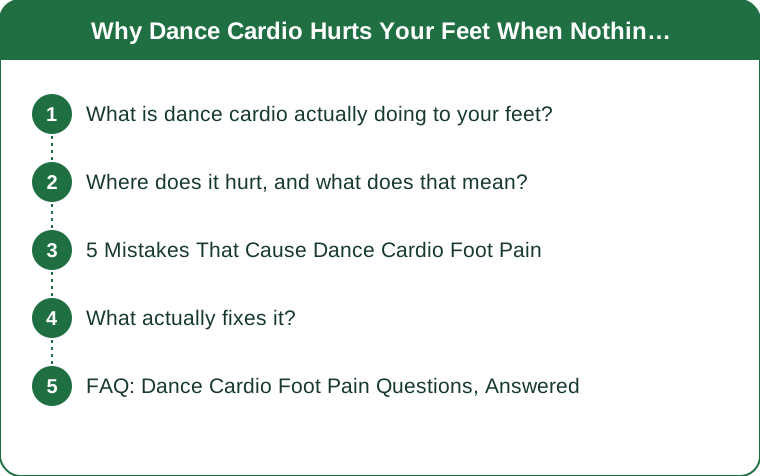
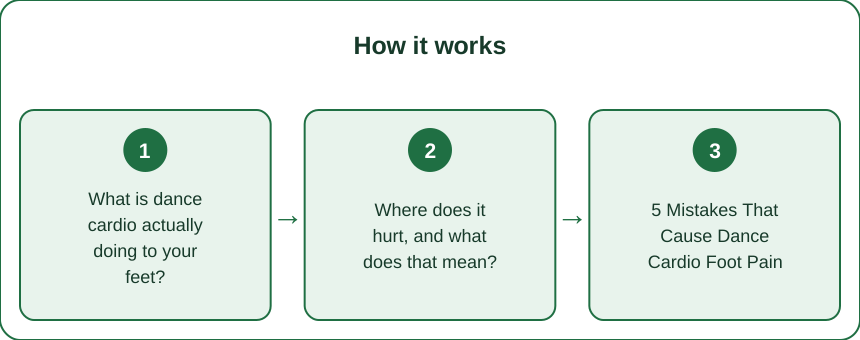
What is dance cardio actually doing to your feet?
Three loading patterns that other cardio barely touches.
Rotation under load. Pivots, twists, and turns rotate the body while the foot is planted. That rotational force has to be absorbed somewhere - in the ankle, the midfoot, or the knee. Running has almost no rotational component; a dance routine can have dozens of pivots in three minutes.
Lateral movement. Side steps, grapevines, and lateral shuffles load the ankle from the side. The ankle is far more stable front-to-back than side-to-side, which is why lateral loading is where most ankle sprains happen across all sports.
Repeated forefoot loading. A great deal of dance cardio happens on the balls of the feet - small bounces, heel lifts, quick steps. That sustains load through the metatarsals and the calf complex continuously rather than in the alternating on-off pattern of walking or running. The calf never fully lengthens, and the forefoot never fully unloads.
And the surface amplifies all three. A carpet or a rubber mat grips the shoe, which is helpful for safety and unhelpful for pivoting - the foot stops rotating while the body keeps going, and the ankle takes the difference. A hard wood or tile floor does the opposite: less grip, but no shock absorption whatsoever.
The result is a workout that feels moderate cardiovascularly while being demanding structurally, which is exactly the mismatch that produces surprise soreness. Your heart rate said this was easy. Your feet were doing something unfamiliar the entire time.
Where does it hurt, and what does that mean?
Location narrows the cause considerably.
Arch pain, worst with the first steps in the morning. This pattern is characteristic of plantar fascia irritation. It is associated with repetitive loading of the arch, particularly barefoot on hard surfaces and with a lot of forefoot work. The morning-first-steps detail is the classic marker.
Pain across the ball of the foot. Metatarsal overload from sustained forefoot work, often worse barefoot or in thin flat shoes. Frequently accompanied by a feeling of walking on a pebble.
Outside of the ankle, aching after lateral moves. Usually the peroneal tendons or general ankle stability structures working hard. Common in people new to lateral movement or returning after a break.
Front of the shin, tight and burning. Anterior tibialis working overtime, usually from a lot of quick toe-lifting and deceleration. Very common in the first few weeks of dance cardio and generally settles.
Calf tightness and Achilles soreness. Sustained forefoot position keeps the calf shortened and loaded. Notably common when people go from cushioned running shoes to barefoot dancing at home.
And the pattern that needs attention rather than management: sharp, localised pain in a specific spot on a bone that worsens with each session, or any pain that makes you limp. That warrants assessment rather than a foam roller. This is general information, not medical advice.
5 Mistakes That Cause Dance Cardio Foot Pain
1. Wearing running shoes. Running shoes are built for forward motion, with soft heel cushioning and an outsole designed to grip going forwards. In a pivot, that grip becomes the problem, and the soft heel provides no lateral stability. This is the single most common cause and the easiest to fix. A cross-trainer with a flatter, firmer sole and a smooth pivot point under the ball of the foot is the correct category.
2. Going barefoot on a hard floor. Barefoot has benefits and a wooden or tile floor is not where you get them. There is no shock absorption and no support during hundreds of forefoot contacts. Barefoot on a proper mat is a reasonable middle ground; barefoot on boards is where arch pain begins.
3. Doing too much too soon. Dance cardio feels easy cardiovascularly, so people go from zero to five sessions a week. The connective tissue in the foot adapts far more slowly than the cardiovascular system does - typically over months rather than weeks. Two or three sessions a week for the first month is not being cautious, it is matching the slowest-adapting tissue.
4. Never strengthening the feet. The feet are the only part of the body most people load heavily and never train directly. Calf raises, toe yoga, and short-foot exercises take five minutes and substantially change tolerance.
5. Ignoring the shoes’ age. A shoe used for dance cardio wears in the pivot zone, not the heel, so it looks fine while the outsole under the ball of the foot has gone smooth or, worse, developed grip patches. If the shoes are over a year old and used regularly, that is a likely contributor.
What actually fixes it?
In order of impact.
Change the surface first. A dedicated exercise mat with genuine cushioning - not a thin yoga mat - under your workout space is the cheapest meaningful change. It provides shock absorption while still allowing enough slide for pivots. Interlocking foam tiles work well and are inexpensive.
Then the shoes. Look for a cross-training or dance-specific shoe with:
- A firm, relatively flat midsole rather than a thick soft heel.
- A pivot circle or smooth zone under the ball of the foot.
- Lateral support through the midfoot.
- Enough toe box width that the forefoot can spread on landing.
Then build the foot and calf. On non-dance days, three exercises, ten minutes:
- Calf raises, 3 sets of 15, slow down-phase. Add a set with knees slightly bent to target soleus, which is the part most involved in sustained forefoot work.
- Single-leg balance, 45 seconds each side, progressing to eyes closed. This builds the ankle stability that lateral moves demand.
- Short foot exercise, drawing the ball of the foot towards the heel without curling the toes, 3 sets of 10 each side.
And modify within the workout. Most dance cardio has a low-impact option for every move; taking it for the jump-heavy sections while your feet adapt is a legitimate long-term strategy, not a beginner’s compromise. Keeping one foot on the floor removes most of the impact while retaining most of the cardiovascular work.
FAQ: Dance Cardio Foot Pain Questions, Answered
What shoes should I wear for dance cardio?
A cross-trainer or dance-specific trainer with a firm flat midsole, a pivot point under the ball of the foot, and lateral midfoot support. Running shoes are the wrong tool - their grip and soft heel work against pivoting and lateral stability.
Can I do dance cardio barefoot?
On a cushioned mat, yes, and some people prefer it. On a hard wood or tile floor it is a common cause of arch and forefoot pain because there is no shock absorption across hundreds of forefoot contacts.
Why do my ankles hurt after dance workouts but not running?
Running is almost entirely forward and vertical. Dance cardio adds rotation and lateral loading, and the ankle is much less stable in those directions. It is a different demand, not a harder workout.
How long does it take for feet to adapt to dance cardio?
Connective tissue adapts over months, not weeks, so expect a gradual build. Two or three sessions a week for the first month, with low-impact modifications on jump-heavy sections, is a sensible progression. Persistent or sharp localised pain should be assessed rather than trained through. This is general information, not medical advice.
TL;DR:
- Dance cardio loads the foot rotationally and laterally, which running never does.
- Running shoes are the wrong shoe - their grip fights every pivot.
- Barefoot on hard floors is where arch pain starts; a cushioned mat solves most of it.
- Sustained forefoot work loads the calf continuously, which explains the Achilles soreness.
- Ten minutes of calf raises, balance work, and short-foot on off days changes tolerance substantially.
The workout is not too hard. It is just asking your feet a question they never get asked anywhere else.
Keep Reading
This article is for general informational and styling purposes only. Fit, sizing, and product availability may vary.