How to Do Dance Cardio in an Apartment Without Annoying Anyone Downstairs
Quick Answer: Impact noise travels through the building structure, so turning the music down does nothing. Remove the jump from jumping moves, land through the whole foot rather than the heel, use a thick mat or interlocking foam over the highest-traffic square metre, and move your session to daytime hours. Together these cut transmitted noise more than any single fix.
The encouraging part: low-impact dance cardio can reach similar heart rates to the jumping version, so the workout does not have to shrink with the noise.
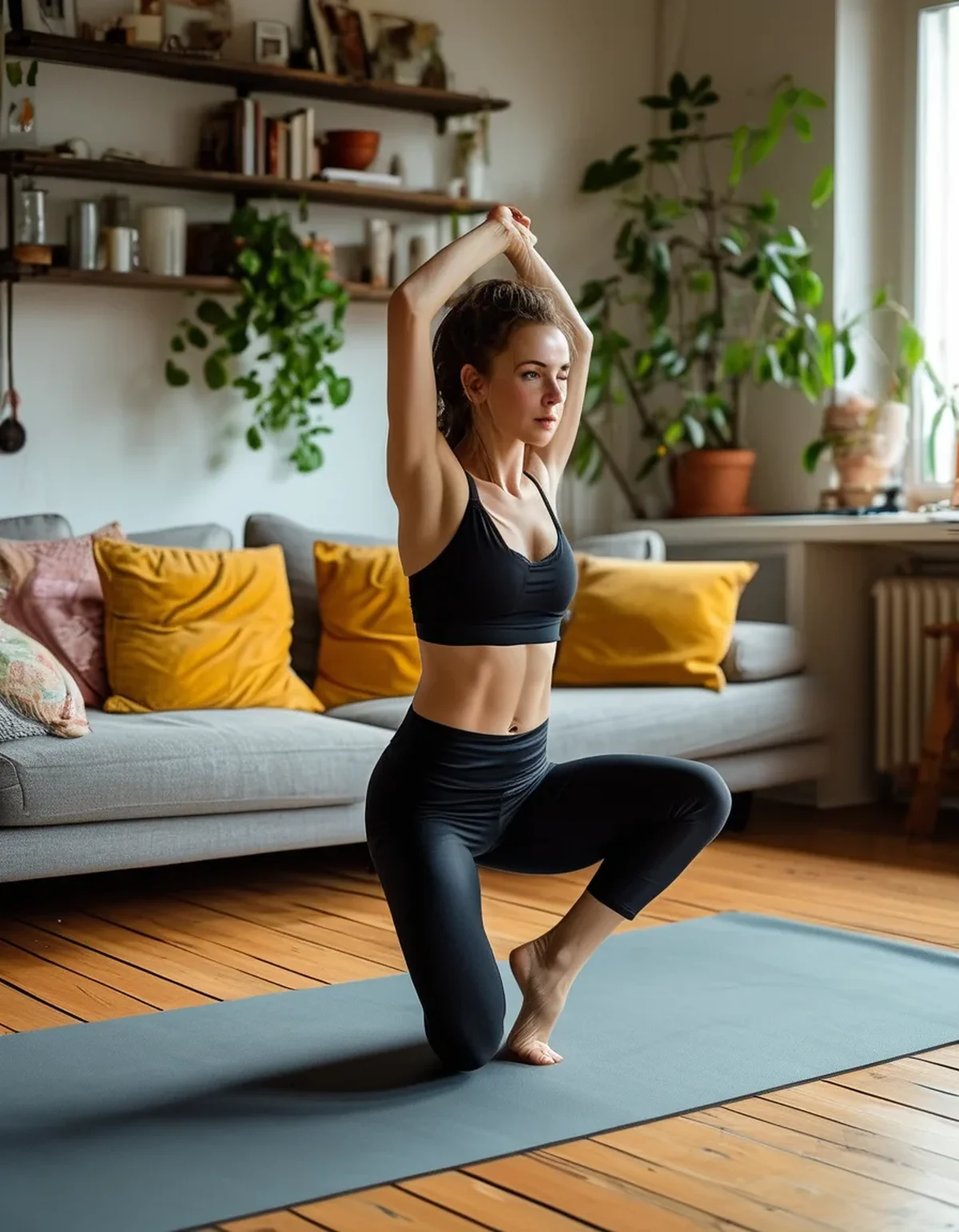
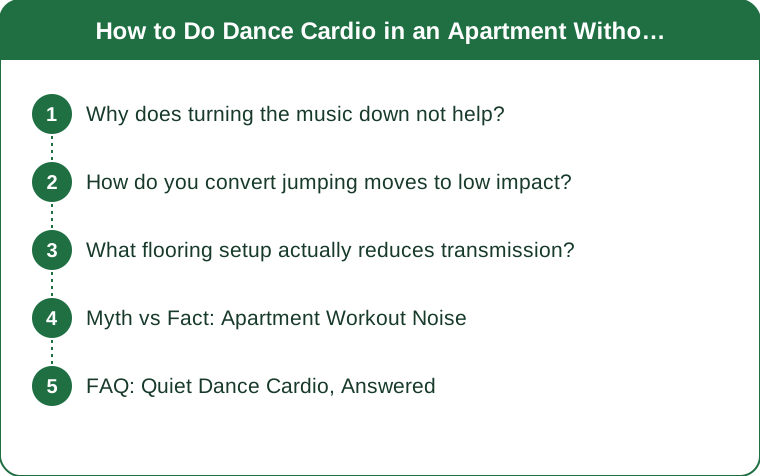
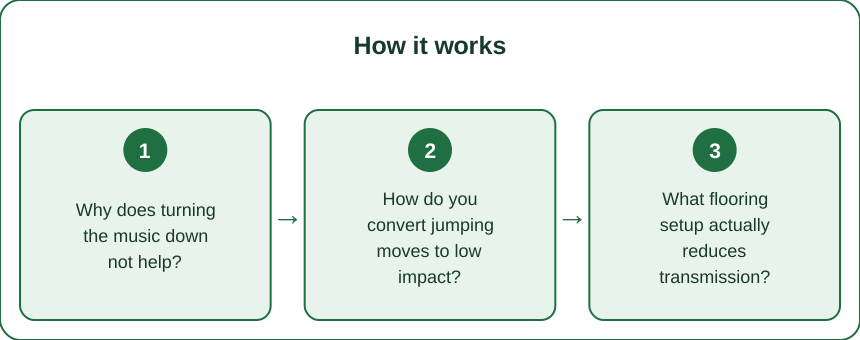
Why does turning the music down not help?
Because there are two entirely different kinds of noise, and you are only controlling one of them.
Airborne noise is what your music makes. It travels through the air, and it is blocked reasonably well by walls, floors and closed doors. It is also the kind neighbors complain about least, unless the volume is genuinely high.
Impact noise, also called structure-borne noise, is created when something strikes the floor. The energy travels through the building’s structure - joists, concrete, walls - and re-radiates as sound in the room below. Concrete transmits it especially efficiently.
Why it is so much worse:
- It bypasses most soundproofing, since it is traveling through solid material rather than air
- It arrives as a low-frequency thud, which is the most intrusive kind of sound and the hardest to mask
- It can be audible several floors down, not just directly below
Which is why the intuitive fixes fail. Headphones, lower volume and closed doors all address airborne noise. The person below is hearing your heels, not your playlist.
What actually reduces impact transmission:
- Less impact created - the highest-leverage change by a wide margin
- Decoupling the impact from the floor with mass and softness between
- Spreading the impact over time, which is what a softer landing does
A useful mental model. A jump landing delivers a large force in a very short time. Softening the landing spreads the same energy over a longer interval, lowering the peak - and peak force is what produces the thud. This is the same physics that makes a controlled landing easier on your joints, which is a convenient overlap.
How do you convert jumping moves to low impact?
Every high-impact dance move has a low-impact translation, and the pattern is consistent.
The general rule: keep one foot in contact with the floor at all times. That single constraint converts most of the repertoire.
Specific swaps:
- Jumping jacks becomes step-out jacks. Step one foot out, then the other, arms doing the same overhead pattern. Same arm work, same rhythm, no flight phase
- Jump squats becomes squat with a calf raise. Same descent, and rise onto the toes at the top for the same extension without leaving the ground
- High knees becomes marching high knees. Slower, higher, more deliberate, with more core engagement
- Skaters becomes lateral step-touch with a reach. Same lateral loading, no leap
- Grapevine with a hop becomes grapevine with a knee lift. The knee lift preserves the accent point in the music
- Burpees becomes step-back to plank, step back up. Loses almost nothing except the jump
How to preserve intensity without impact:
- Increase range of motion. Deeper squats, bigger arm patterns, larger lateral steps. Range costs energy
- Add tempo. Faster footwork keeps the heart rate up without adding jump height
- Add arms. Raising the arms overhead raises heart rate meaningfully, which is why arm-heavy choreography feels harder
- Reduce rest between tracks rather than adding intensity within them
What the research suggests. Low-impact aerobic formats have been shown to produce comparable heart rate responses to high-impact versions when the range and tempo are increased to compensate. You are not automatically training less - you are training differently, and the joint load is lower, which is a genuine bonus for anyone with knee or hip issues.
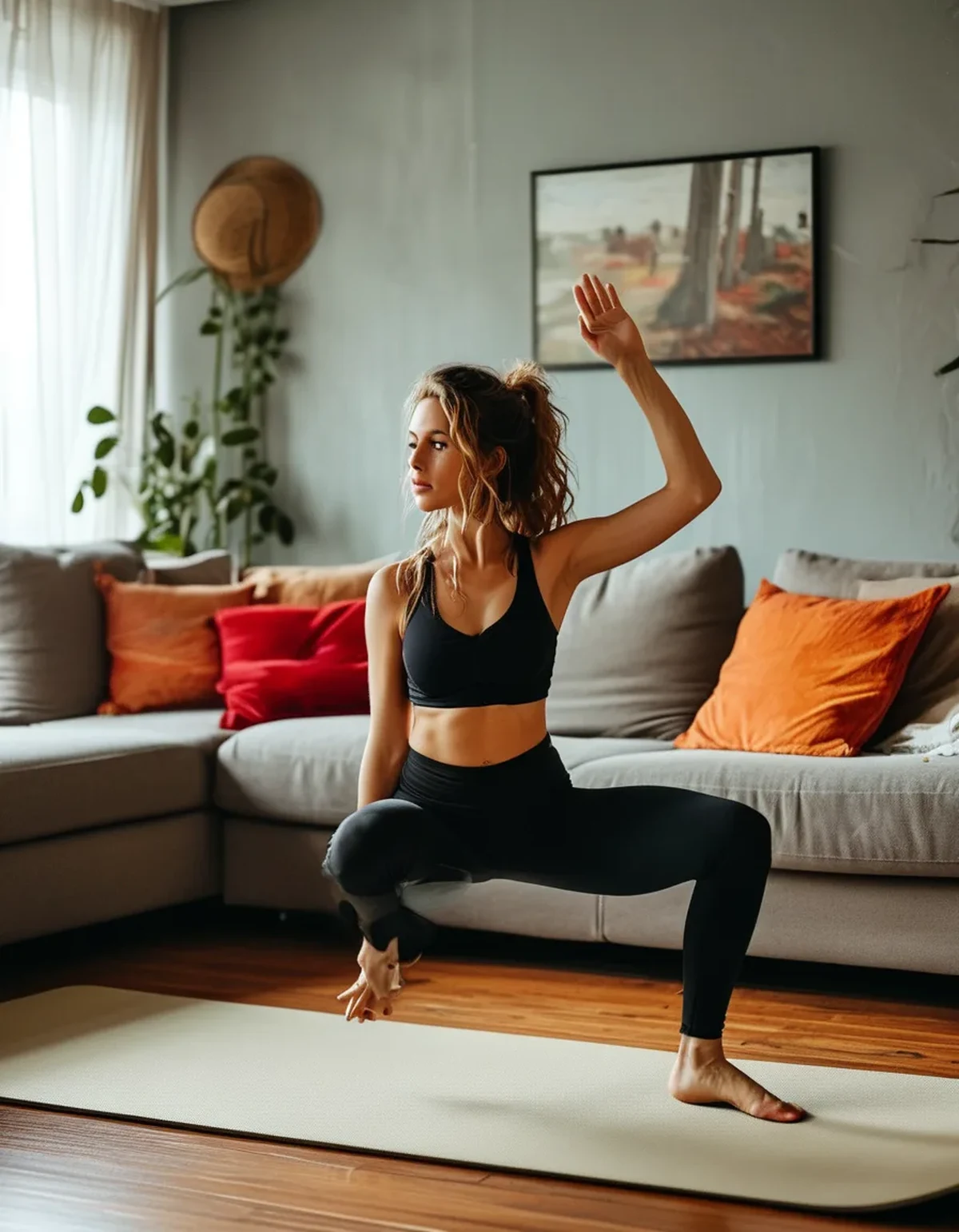
What flooring setup actually reduces transmission?
Mass plus softness, over a small area, works better than a thin mat over a large one.
In order of effectiveness for a home setup:
- Interlocking EVA foam tiles, 20mm or thicker. The standard home gym solution and genuinely effective. Two square metres is enough for most dance cardio
- A thick yoga or exercise mat, 10 to 15mm, which is a meaningful improvement over a bare floor and a poor substitute for foam tiles
- A rug with a thick underlay, which helps somewhat and mostly for higher frequencies
- Carpet alone, which barely affects low-frequency impact
Layering works better than any single product. Foam tiles on top of an existing carpet, or a mat on top of foam tiles, outperforms either alone. The principle is alternating layers of mass and softness, which is exactly how commercial acoustic flooring is constructed.
Where you place it matters as much as what it is:
- Away from the center of the room. Floor spans flex most in the middle, and flexing floor radiates more sound below
- Near a load-bearing wall if possible, where the floor is stiffest
- Not directly above a bedroom, which is worth checking if you can work out where your neighbor’s rooms are
Technique changes that cost nothing:
- Land through the ball of the foot then the heel, rather than flat or heel-first. This is the single largest free improvement available
- Bend the knees on landing. Stiff-legged landings transmit far more
- Stay off the heels generally. Heel strike during ordinary steps is a surprisingly large noise source
- Wear supportive shoes rather than going barefoot, since cushioned soles absorb some impact - though good technique matters more
On timing, which is the most underrated fix. Most noise complaints concern evening and early morning. Moving a session to between 10am and 6pm resolves a large share of neighbor conflicts without changing anything about the workout.
Myth vs Fact: Apartment Workout Noise
Myth: Using headphones solves the problem. Fact: Headphones eliminate airborne music noise and do nothing about the impact noise your feet create, which is what neighbors actually hear.
Myth: A yoga mat is enough. Fact: A standard 5mm yoga mat has minimal effect on low-frequency impact. Thicker foam, ideally layered, is what makes a measurable difference.
Myth: Low-impact means low-intensity. Fact: Increasing range of motion, tempo and arm involvement brings low-impact formats to comparable heart rates. The intensity lever is not the jump.
Myth: Carpet blocks impact noise. Fact: Carpet absorbs higher frequencies and does relatively little for the low-frequency thud that travels through structure. This is why carpeted apartments still generate complaints - the residents assume they are covered and are not.
Myth: Concrete buildings are quieter. Fact: Concrete is excellent at blocking airborne sound and an efficient transmitter of impact noise. Many people in concrete buildings are surprised to hear footsteps from three floors up.
Myth: If nobody has complained, it is fine. Fact: Most people never complain; they just resent it. If you are doing jumping workouts on a hard floor above a neighbor, they can almost certainly hear you.
FAQ: Quiet Dance Cardio, Answered
Why can my neighbors hear me even with the music off?
Impact noise travels through the building structure rather than the air, so it bypasses the barriers that block music. Your footfalls are the source.
Does low-impact dance cardio still count as a workout?
Yes. With larger range of motion, faster tempo and more arm work, low-impact formats reach comparable heart rates to high-impact versions.
What flooring works best?
Interlocking EVA foam tiles 20mm or thicker, ideally layered over existing carpet. Two square metres is enough. A thin yoga mat is not sufficient on its own.
Should I work out barefoot or in shoes?
Shoes, generally - cushioned soles absorb some impact and support the foot during lateral movement. Landing technique matters more than either choice.
When is the best time to avoid complaints?
Between roughly 10am and 6pm. Most complaints concern early mornings and evenings, and moving the session often resolves the issue entirely.
What is the single most effective change?
Removing the flight phase - keeping one foot on the floor at all times. It reduces impact more than any equipment purchase.
TL;DR:
- Neighbors hear impact noise through the structure, not your music, so volume and headphones change nothing
- Keep one foot on the floor at all times: step-out jacks, squat-to-calf-raise, marching high knees, step-back planks
- Restore intensity with range of motion, tempo and overhead arm work rather than jump height
- Layer 20mm interlocking foam over carpet, near a wall rather than mid-span, and land ball-of-foot with bent knees
- Move sessions to daytime hours - it resolves more complaints than any equipment
Low-impact is not low-intensity. The jump is the noise, not the workout.
Keep Reading
This article is for general informational and styling purposes only. Fit, sizing, and product availability may vary.