You Learned the Choreography — So Why Did Your Dance Cardio Get Easier?
Quick Answer: Early dance cardio is hard partly because you are learning — your brain is working, movements are inefficient, and you make big wasteful corrections. As you master the choreography you become movement-efficient, meaning the same routine costs less energy. That feels like a fitness plateau but it is actually a skill gain. Fix it by changing the routine, adding range and load, or increasing tempo — not by adding more of the same class.
Six weeks ago this class destroyed you. Now you know every count and you finish barely winded.
You did not stop getting fitter. You got good at it, and getting good at something makes it cheaper.
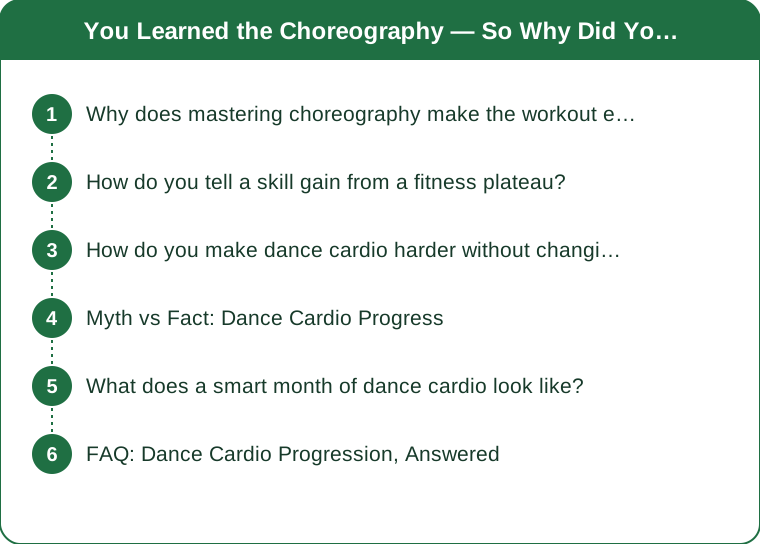
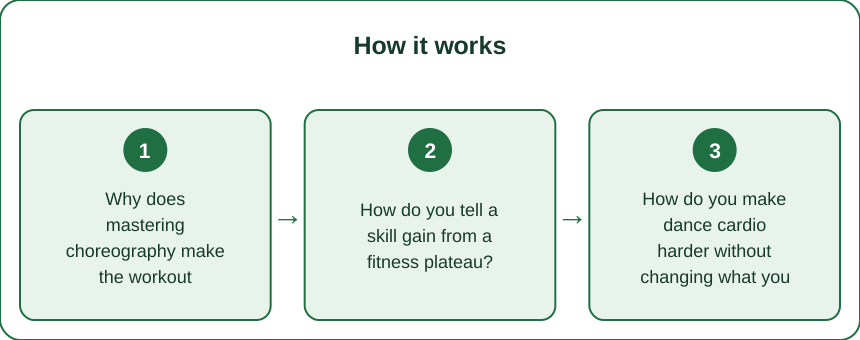
Why does mastering choreography make the workout easier?
Because most of the difficulty in a new dance routine is neurological, not cardiovascular.
When you learn an unfamiliar movement, your nervous system recruits far more muscle than the task requires. You co-contract opposing muscles to stabilize, you make large corrections mid-movement, and you brace in places you do not need to brace. All of that costs energy. Learners are, in a very literal sense, inefficient.
As the pattern consolidates, the nervous system prunes. It recruits only the muscle needed, stops the unnecessary co-contraction, and times the movements to use elastic recoil in tendons rather than raw muscular effort. The same choreography starts costing measurably less oxygen.
There is a second layer specific to dance. Not knowing what comes next forces you to react late, which means every transition is a hard start-stop. Once you anticipate the next move, you start flowing into it early, converting a series of sharp accelerations into smooth continuous motion. Sharp accelerations are metabolically expensive; flow is cheap.
And a third: the cognitive load itself has a real energy cost, plus it raises heart rate through arousal and stress response. Concentrating hard on remembering counts genuinely elevates heart rate independent of the physical work. That contribution disappears once you know it.
All three effects run in the same direction, and together they explain a substantial drop in workout intensity for the identical routine.
How do you tell a skill gain from a fitness plateau?
They feel identical from the inside, and they call for opposite responses. Here is how to separate them.
Signs it is a skill gain — good news:
- The specific routine got easier, but a new unfamiliar routine still challenges you
- Your heart rate is lower during the same class than it was a month ago at the same points
- You feel more coordinated and less flustered, not just less tired
- You recover faster between tracks
- Other cardio — a run, a bike, stairs — has also gotten easier
Signs it is an actual plateau:
- New routines are also not challenging you at the same effort
- Your heart rate does not climb the way it used to no matter what you do
- Other activities have not improved alongside it
- You have been doing the same class, same duration, same intensity for two or more months
The clean test: take a completely unfamiliar routine, ideally a different instructor or style. If it feels hard again, your fitness is fine and your routine went stale. If it feels similarly easy, you have genuinely stopped progressing and need a change in training stimulus.
A more objective version: if you have a heart rate monitor, compare average and peak heart rate for the same class across a month. A steadily dropping average at the same class is the efficiency curve in numbers. That is exactly what improvement looks like — and exactly why you now need a harder input.
How do you make dance cardio harder without changing what you love about it?
Five levers, roughly in order of how much they change things.
1. Rotate routines every three to four weeks. The single most effective change. Novelty restores the learning cost, and varied movement patterns build broader coordination. Keep two or three routines in rotation rather than mastering one to death.
2. Increase range of motion deliberately. Same choreography, bigger movement. Deeper squats, higher knees, fuller arm extension, lower lunges. This is free intensity that most people leave on the table because efficient movement naturally shrinks. Consciously making movements larger reverses the exact adaptation that made it easier.
3. Add light load. One to three pound hand weights change the arm work substantially, and a weighted vest changes everything. Start light — dance cardio involves fast direction changes, and heavy weights in that context are a shoulder and wrist risk, not a progression.
4. Raise the tempo. Many routines work at 5 to 10 percent faster playback, and the effect on intensity is large. Do this only on choreography you know well and only where you can maintain form; it is a poor idea on knee-loading movements.
5. Add plyometric variations. Where the routine has a step-touch, make it a hop. Where there is a squat, make it a jump squat. Add these selectively, not everywhere — full-routine plyometrics is a fast route to sore knees and shins.
What does not work: simply doing more classes per week at the same intensity. Volume without intensity produces very slow improvement once you are efficient at the movement, and it is the most common thing people try.
Myth vs Fact: Dance Cardio Progress
Myth: If it got easier, you stopped burning calories. Fact: You burn somewhat less for the identical routine, because efficiency is real. But you can also now work at a higher intensity than you could before, so total output goes up if you actually use the new capacity.
Myth: Dance cardio does not count as real cardiovascular training. Fact: Sustained dance cardio at genuine effort produces the same cardiovascular adaptations as any other continuous aerobic work. The problem is not the modality; it is that familiar choreography drifts down in intensity without you noticing.
Myth: You should stick with one instructor to master the style. Fact: For skill development, depth helps. For fitness, variety wins clearly. Rotating instructors and styles maintains both learning cost and movement variety, and the coordination transfers.
Myth: Sweating a lot means it worked. Fact: Sweat rate reflects room temperature, humidity, hydration, and individual variation far more than exercise intensity. An efficient dancer in a hot room sweats plenty while working easily.
Myth: More coordination means you need less warm-up. Fact: Efficient movement is faster and larger, which means higher forces on cold tissue. Experienced dancers arguably need warm-up more, not less, because they hit full intensity within the first minute.
Myth: A plateau means you should switch to running. Fact: A plateau means your current stimulus stopped being novel. Changing modality works, but so does changing the routine, and you are far more likely to keep doing the thing you enjoy.
What does a smart month of dance cardio look like?
A structure that keeps the fun and restores the progression.
Week 1 — new routine. Expect to feel uncoordinated and to work hard for reasons that are half cognitive. Do not add weights or increase range yet; learn the pattern.
Week 2 — same routine, full range. You know it now, so make every movement as large as you can control. This is where you consciously undo the efficiency gain.
Week 3 — add one intensity lever. Light hand weights, or selected plyometric variations, or a modest tempo increase. One lever, not three.
Week 4 — max effort on the mastered routine. You know it well enough to push without thinking. This should be your hardest session of the block.
Then rotate to a new routine and repeat.
Alongside that, two things worth adding:
Some strength training. Dance cardio builds coordination and endurance but loads muscle relatively lightly. Two sessions a week of basic resistance work supports the dancing itself, particularly for knee and ankle stability on direction changes.
One genuinely easy session. Not everything should be hard. A low-intensity dance session for enjoyment supports recovery and is a large part of why people stick with this modality for years.
One caution worth flagging: if you have knee, hip, or ankle pain that shows up specifically during direction changes or landings, add range and plyometrics much more slowly, and get it assessed if it persists past a couple of weeks. Progression should be uncomfortable in the lungs, not in the joints. This is general information, not medical advice.
FAQ: Dance Cardio Progression, Answered
How often should I change routines?
Every three to four weeks is a good default. Sooner and you never get to push a routine you know well; much later and the efficiency gain has already flattened your intensity.
Are hand weights actually worth it?
For arm-heavy choreography, yes — one to three pounds changes the upper body work noticeably. Avoid anything heavier during fast direction changes, and skip them entirely on routines with a lot of arm swinging.
Should I use a heart rate monitor?
It is the clearest way to see the efficiency curve, which is otherwise invisible. Watching your average heart rate for the same class drop over a month is genuinely motivating once you understand what it means.
Is it bad that I keep doing my favorite routine?
No, as long as it is not your only one. Keep the favorite for the days you need to just move and enjoy it, and rotate something new alongside it for the training effect.
TL;DR: Your dance cardio got easier because you got good at it, not because you stopped improving.
- Learning costs energy. Efficient movement, anticipation, and lower cognitive load all reduce the cost of the same routine.
- Test it: try an unfamiliar routine. Still hard means skill gain; still easy means genuine plateau.
- Rotate routines every three to four weeks — the single most effective fix.
- Consciously increase range of motion, which directly reverses the efficiency adaptation and costs nothing.
- Add light weights, tempo, or selected plyometrics — one lever at a time.
- More classes at the same intensity is the least effective response, and the most commonly attempted.
Swap in one new routine this week and notice how hard it feels. That is your fitness talking, not your memory.
Keep Reading
This article is for general informational and styling purposes only. Fit, sizing, and product availability may vary.