Dance Cardio in a Cold Room: The Warm-Up Changes That Prevent Injuries
Quick Answer: Dance cardio is uniquely exposed to cold because it starts fast and involves rapid direction changes on one leg - exactly the loading pattern that cold calves and ankles handle worst. In a room under about 65F, extend the warm-up to 8-10 minutes, keep the first two songs at half amplitude, and leave a layer on until you are visibly warm. Do not skip straight to the choreography because the playlist starts there.
The injuries that show up in home dance workouts in autumn are remarkably consistent: calf strains, ankle rolls, and a specific ache on the outside of the knee. All three trace back to the same starting condition.

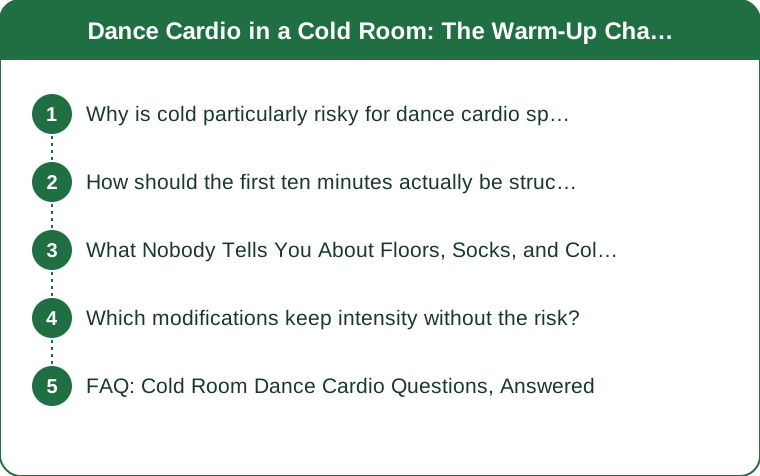
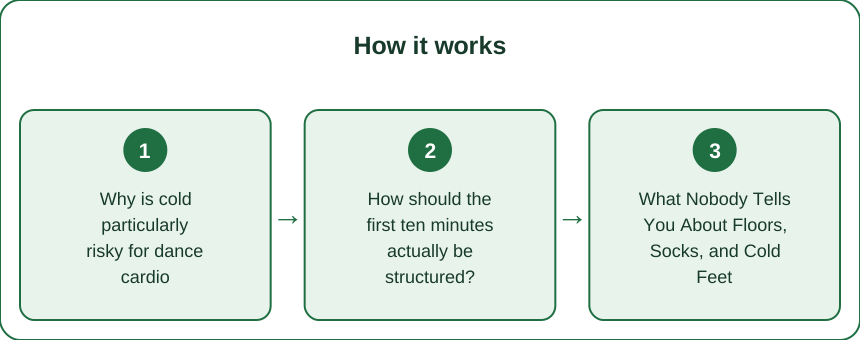
Why is cold particularly risky for dance cardio specifically?
Most home workouts ramp. Dance cardio, by design, does not - the first song is already at tempo, with weight shifts, pivots, and single-leg loading from the opening count.
Cold muscle is stiffer and produces force more slowly. Cold tendons store and release elastic energy less efficiently. Neither of those matters much for a slow squat. Both matter enormously for a fast lateral push-off followed by a landing on one foot, which is roughly what a dance cardio class asks of your calves and ankles a few hundred times.
The calf is the standout risk. It is the muscle group most involved in explosive push-off, it sits close to the skin surface where it cools fastest, and in a home setting it is often working on a hard floor without the shoe cushioning a studio class would have.
The ankle is second. Proprioception - your sense of where the joint is in space - is measurably reduced when tissue is cold, which means the small corrections that normally prevent a roll happen a fraction slower.
Add the home-specific factors and the risk compounds: a hard floor, bare feet or socks, less space than the instructor has, and no one watching your form. Cold is the variable that turns those from manageable into a strain.
How should the first ten minutes actually be structured?
Minutes 0-3: get warm before you get moving fast.
- March in place, arms swinging, building from slow to brisk.
- Ankle circles, 10 each direction, both feet.
- Calf raises, 20 slow, then 20 with a small bounce at the top.
- Keep a long-sleeve layer on for this entire section.
Minutes 3-6: full range, low speed.
- Step touches at half tempo, going all the way to full range.
- Hip circles and leg swings, 10 each direction per leg.
- Torso rotations, arms loose.
- Small squats, 15, warming the quads and glutes.
Minutes 6-8: speed without amplitude.
- Now bring in the actual movement patterns of your class - grapevines, pivots, step-hops - but at half the size. Same tempo, smaller range. This is the step most people skip and it is where the nervous system rehearses the pattern before loading it.
Minutes 8-10: amplitude up.
- Grow the range to full over two or three minutes. By the time the first real song starts, you should be slightly sweaty and have removed the top layer.
A rule of thumb: if you can still feel cold air on your forearms, you are not warm enough for a jump. Body temperature, not clock time, is the actual signal - a 63F room needs longer than a 72F one.

What Nobody Tells You About Floors, Socks, and Cold Feet
The surface question changes with the season and almost nobody adjusts for it.
Cold hard floors are harder. Materials get stiffer as they cool, so a laminate or tile floor genuinely returns more impact force to your joints on a cold morning than the same floor in August. Concrete slab under laminate, common in basements and ground floors, is the worst case.
Bare feet lose heat fast on a cold floor, and cold feet are the ones that roll. Foot temperature drops much faster than core temperature because of the surface-area-to-mass ratio and the tile conducting heat straight out of you.
What actually helps:
- A large exercise mat or a rug under the workout area. This is the single best change - it insulates and it cushions.
- Grippy socks with a rubberized sole, which solve the temperature problem and the slipping problem at once. Regular socks on laminate are how people go down.
- Supportive shoes if your space and downstairs neighbors allow, particularly for high-impact classes. Cushioning matters more on a cold floor.
One more thing nobody mentions: the cold-floor-hot-room combination is common in autumn, where the heating warms the air but the floor stays cold for hours. Your torso feels perfectly warm while your feet and calves are still at morning temperature. That mismatch is exactly the setup for a calf strain, and it is why body-temperature check should be done at the ankle, not the forehead.
Which modifications keep intensity without the risk?
You do not have to make the workout easier - just shift where the load goes.
Swap jumps for pushes early. In the first two songs, replace jumping jacks with step-out jacks and hops with weight transfers. You keep the heart rate and cadence, and you remove the eccentric landing load on a cold calf. Add the jumps back from song three onward.
Reduce the pivot, keep the tempo. Pivots on a planted foot are where knees complain in the cold. Take a small step to change direction instead of twisting on a fixed foot for the first ten minutes.
Use the arms more. Bigger arm movement raises heart rate substantially with no lower-body impact at all - a genuinely useful trade in the warm-up window.
Watch the last song, not just the first. Form degrades with fatigue, and a cold room means you cool down faster during any pause. If the class has a slow section in the middle, keep marching through it rather than standing still. Standing still in a cool room for two minutes puts you halfway back to where you started.
And cool down properly. In a cold room the temptation is to stop and get warm immediately. Three minutes of walking and calf stretching before you sit down reduces next-day soreness noticeably. This is general information, not medical advice - a calf that goes sharply painful mid-session needs assessment, not stretching.
FAQ: Cold Room Dance Cardio Questions, Answered
What room temperature is actually fine?
Most people are comfortable working out between 65-72F. Below 65F you should extend the warm-up meaningfully. Below 60F, consider heating the room for twenty minutes first - it is cheaper than a six-week calf recovery.
Should I keep layers on the whole time?
Start layered, remove once genuinely warm, and put a layer back on the moment you finish. The cool-down is when people get chilled, and a chilled muscle after a hard session is the one that seizes up overnight.
Why do my shins hurt more in the fall?
Shin splints in home workouts usually trace to a hard cold floor plus insufficient warm-up plus a jump in workout frequency. Add a mat, add warm-up time, and check whether you increased your weekly volume at the same time the weather changed.
Is it better to work out in the evening when the house is warmer?
If your schedule allows, yes - a warmer room genuinely reduces warm-up requirements. Just note that many homes are warmest in the evening and coldest at 6 am, which is exactly when most people work out.
TL;DR:
- Dance cardio starts fast, which is the worst possible profile for cold calves and ankles.
- Extend the warm-up to 8-10 minutes, ending with full-tempo, half-amplitude rehearsal of the actual moves.
- Put a mat or rug down and wear grippy socks - cold hard floors return more impact and cold feet roll.
- Swap jumps for weight transfers in the first two songs, and never stand still in a cool room mid-session.
The workout does not need to get easier when the house gets cold. The first ten minutes just need to get longer.
Keep Reading
This article is for general informational and styling purposes only. Fit, sizing, and product availability may vary.