Why You Run Out of Breath in Dance Cardio Before Your Legs Get Tired
Quick Answer: In dance cardio, most people get breathless before their legs fatigue because they unconsciously hold their breath through complex sequences, brace their core continuously, and add arm movements above shoulder height, which all raise the breathing cost while masking it. The fix is not more cardio fitness. It is breathing on a fixed rhythm rather than on the choreography, dropping the arms first when you get short of breath, and learning the sequence at half speed so you are not concentrating hard enough to hold your breath.
Your quads feel fine. Your calves feel fine. Four minutes in you are gasping and the instructor is talking cheerfully about the next combination.
That mismatch is a clue, and it points somewhere specific.
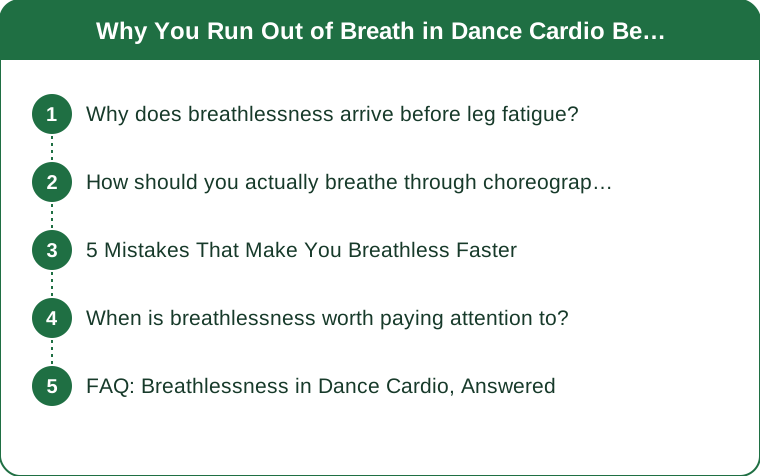
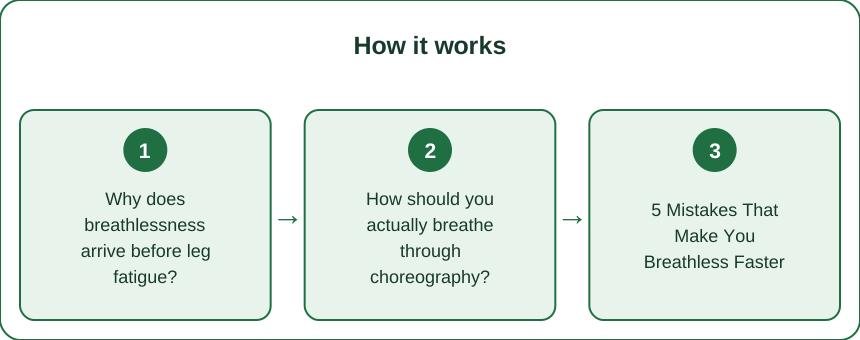
Why does breathlessness arrive before leg fatigue?
You are almost certainly breath-holding through the hard parts. When you concentrate on a movement you have not automated, you tend to hold your breath. Choreography is a constant stream of new movements to concentrate on, so the breath-holding is nearly continuous rather than occasional.
Continuous core bracing restricts the diaphragm. Holding a strong abdominal brace to feel controlled during fast direction changes limits how far your diaphragm can descend, so each breath moves less air and you compensate with a faster, shallower rate.
Arms above shoulder height raise the cost quickly. Working the arms overhead recruits more muscle mass and raises heart rate and breathing rate substantially - often more than an equivalent amount of leg work, because the arm muscles are smaller and fatigue faster relative to the demand.
The intensity is genuinely uneven. Dance cardio moves between hard sequences and easier ones with no structured recovery, so you can spend two minutes above a sustainable intensity without noticing until your breathing catches up.
Leg muscles are large and efficient. Big muscle groups doing familiar movements like stepping and squatting are metabolically efficient, so the local fatigue signal from your legs arrives later than the whole-body breathing signal.
And unfamiliar movement costs more energy than familiar movement. Learning a sequence is less efficient than performing one you know, which is why the same routine feels dramatically easier the fourth time you do it.
How should you actually breathe through choreography?
Breathe on a fixed rhythm, not on the movement. Pick a pattern - in for two counts, out for two - and keep it going regardless of what the choreography is doing. Attaching breath to movement fails as soon as the movement gets complicated.
Exhale on the effort where you can. On jumps, presses, and direction changes, a deliberate exhale prevents the automatic hold. Even audible breathing works, and many instructors cue it for exactly this reason.
Keep the mouth slightly open. Nasal breathing is fine at low intensity and becomes a limitation at higher intensity, where you need more airflow than the nose can supply.
Let the ribs move. A soft, mobile ribcage lets you take genuinely deep breaths. If you are gripping your abs hard the entire class, you are trading breathing capacity for a feeling of control.
Use the transitions. The moments between combinations, when the instructor is explaining the next sequence, are your recovery windows. Take two deliberate deep breaths there rather than mirroring their arm demonstration.
And practise the breathing pattern at low intensity first. Marching in place with a two-count breathing rhythm for a minute establishes the pattern so it is available when the routine speeds up.

5 Mistakes That Make You Breathless Faster
Mistake 1: Full arms from the first track. Arms overhead raise the breathing demand sharply. Adding them in the second half of a class rather than the first is the single easiest adjustment available.
Mistake 2: Trying to learn the sequence at full speed. Concentration causes breath-holding. Learning the pattern at half speed for one round and then joining at full speed removes most of the problem.
Mistake 3: Bracing your core continuously. Bracing is for moments of load, not for forty minutes. Continuous bracing restricts the diaphragm and gains you nothing in a dance class.
Mistake 4: Stopping completely when breathless. Coming to a full stop causes blood to pool and often makes you feel worse. Marching in place while your breathing recovers is more effective and keeps you in the class.
Mistake 5: Doing dance cardio in a warm, unventilated room. Heat raises heart rate at any given workload and makes breathing feel harder. A fan and an open window change the experience more than most people expect.
The one that surprises people is the fourth. The instinct is to stop dead, and it is exactly the response that makes the recovery take longer.
When is breathlessness worth paying attention to?
Getting breathless during hard exercise is normal. Breathing hard, needing to pause, and recovering within a minute or two of easing off is exactly what should happen in a demanding cardio session.
Recovery speed is the useful signal. If your breathing settles within a couple of minutes of reducing intensity, that is typical. Breathlessness that persists long after you stop is not.
Watch for symptoms that do not fit. Wheezing, chest tightness, coughing that starts several minutes into exercise, dizziness, or breathlessness far out of proportion to the effort are worth mentioning to a clinician. Exercise-induced symptoms are common and treatable.
Note whether it is new. A change from your own baseline matters more than an absolute level. If a class you handled comfortably last month now leaves you gasping, that is information.
Consider the environment and the season. Heat, humidity, air quality, and pollen all affect breathing during exercise, and late summer combines several of them.
This is general information, not medical advice. Anyone with asthma, a heart condition, or new and unexplained breathlessness should get individual guidance rather than working around it.
FAQ: Breathlessness in Dance Cardio, Answered
Why am I out of breath but my legs are not tired?
Usually breath-holding during choreography, continuous core bracing, and arm movements above shoulder height. All three raise the breathing demand while your large, efficient leg muscles are still comfortable.
How should I breathe during dance cardio?
Use a fixed rhythm - in for two counts, out for two - rather than trying to match the movement, and exhale deliberately on jumps and direction changes. Keep your mouth slightly open at higher intensity.
Should I stop when I get breathless?
March in place rather than stopping dead. Active recovery clears the breathlessness faster and keeps you in the class, whereas a full stop often feels worse.
Will this improve with fitness?
Yes, partly - but the biggest early gains come from learning the choreography, since familiar movement is more efficient and requires less concentration, which means less breath-holding.
TL;DR:
- Breathlessness before leg fatigue usually means you are holding your breath through choreography, not that your cardio fitness is poor.
- Continuous core bracing restricts the diaphragm, and arms above shoulder height raise breathing demand sharply.
- Breathe on a fixed count rather than on the movement, exhale on jumps and direction changes, and keep the ribs mobile.
- Drop the arms first when you get short of breath, march in place instead of stopping dead, and cool the room.
- Familiar choreography is far cheaper to perform - the same routine gets noticeably easier by the fourth attempt.
Your legs are not lying to you. Your breathing just got left out of the choreography.
Keep Reading
This article is for general informational and styling purposes only. Fit, sizing, and product availability may vary.