Why Your Dance Cardio Results Plateaued (and the Actual Fix)
Quick Answer: Dance cardio plateaus most often because the body adapts to a repeated routine’s specific movement patterns and intensity, reducing the workout’s relative challenge over time even though it feels just as tiring subjectively. The fix is rotating in new choreography or increasing intensity variables (range of motion, tempo, added arm work) every 4-6 weeks rather than repeating the same routine indefinitely.
The first few weeks of a dance cardio routine brought visible results, and then progress quietly stopped despite putting in the same effort - here’s the actual mechanism behind that, and what breaks through it.

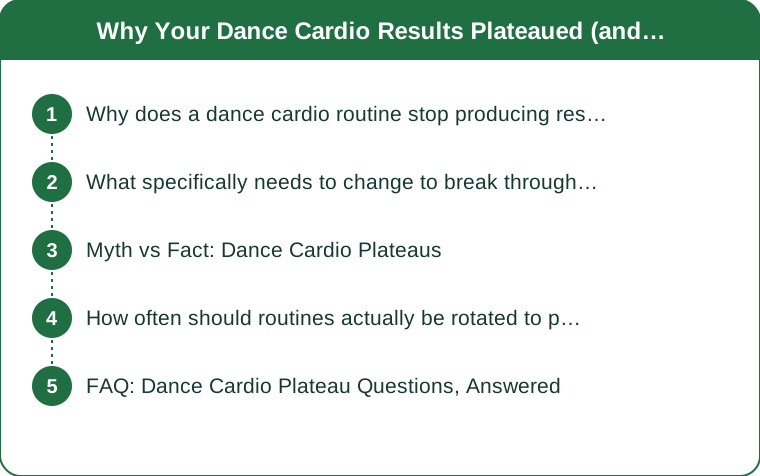
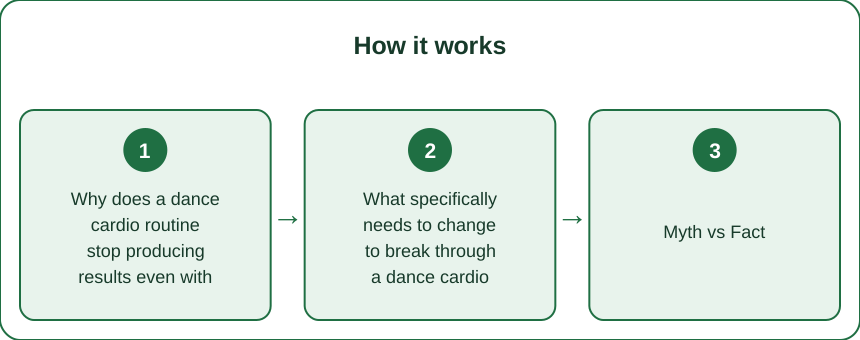
Why does a dance cardio routine stop producing results even with consistent effort?
The body adapts to repeated, familiar movement patterns by becoming more efficient at performing them - which is generally good for skill, but means the same routine burns fewer calories and provides less cardiovascular challenge over time relative to when it was new. This adaptation happens gradually over roughly 4-8 weeks of consistent repetition, which lines up with when most people notice their plateau starting.
This isn’t a motivation or effort problem - it’s a genuine physiological adaptation, which is exactly why simply “trying harder” at the same routine often doesn’t restore the earlier results.
What specifically needs to change to break through a dance cardio plateau?
New choreography is the most direct fix, since unfamiliar movement patterns require more neuromuscular coordination effort, which itself burns more calories and creates more challenge even at a similar physical intensity level to a familiar routine. This doesn’t need to mean an entirely new class style - swapping specific combinations or sequences within a familiar genre is often enough.
Increasing specific intensity variables - larger range of motion in the same moves, faster tempo, adding arm movements to routines that were previously lower-body focused - also restores challenge without needing entirely new choreography, which can be a faster adjustment for people who prefer their current routine’s overall style.

Myth vs Fact: Dance Cardio Plateaus
Myth: A plateau means you need to switch to a completely different type of workout. Fact: Staying within dance cardio but rotating choreography or intensity variables is often sufficient - a full workout type switch isn’t necessary just to break a plateau.
Myth: If a routine still feels tiring, it’s still providing the same benefit as when it was new. Fact: Subjective fatigue and actual physiological challenge can diverge once a routine becomes familiar - feeling tired doesn’t guarantee the same calorie burn or cardiovascular benefit as earlier weeks.
Myth: Plateaus only happen to people doing low-intensity dance cardio. Fact: Adaptation to familiar movement happens regardless of the routine’s original intensity level - even a genuinely challenging routine plateaus once the body adapts to its specific patterns.
How often should routines actually be rotated to prevent this from happening again?
Rotating new choreography or meaningfully increasing intensity variables every 4-6 weeks tends to stay ahead of the adaptation timeline for most people, based on when plateaus commonly become noticeable. This doesn’t require an entirely new routine each time - even swapping 2-3 combinations within an otherwise familiar routine provides enough novelty to maintain challenge.
Tracking a simple marker - perceived effort at a consistent point in the routine, or a basic heart rate check if available - helps notice early plateau signs before weeks of reduced benefit accumulate, making the rotation timing more responsive to your actual results rather than a fixed calendar schedule.
FAQ: Dance Cardio Plateau Questions, Answered
Does adding weights or resistance bands help break a dance cardio plateau?
Yes - added resistance is another valid intensity variable, working similarly to tempo or range-of-motion increases in restoring workout challenge without needing new choreography.
Is it normal to plateau multiple times even with regular routine rotation?
Yes - plateaus can recur as the body adapts to new routines too, just typically on a longer timeline than with a completely unchanged routine, so periodic rotation remains an ongoing practice, not a one-time fix.
Should I completely stop a routine I enjoy just because results have plateaued?
Not necessarily - modifying the routine (new sequences, increased intensity variables) while keeping its overall style and music you enjoy often restores results without needing to abandon a routine you genuinely like.
TL;DR:
- Dance cardio plateaus happen because the body adapts to familiar movement patterns, not from reduced effort
- New choreography restores challenge through added neuromuscular coordination demand
- Increasing tempo, range of motion, or adding arm work also breaks through without new routines
- Rotating routines or intensity every 4-6 weeks stays ahead of the typical adaptation timeline
A plateau doesn’t mean the routine failed - it means the body did exactly what it’s supposed to do by adapting, and it’s time to change the specific challenge, not the effort.
Keep Reading
This article is for general informational and styling purposes only. Fit, sizing, and product availability may vary.