The Shoe and Floor Combination That Is Wrecking Your Dance Cardio
Quick Answer: Running shoes are the most common and worst choice for dance cardio, because their grippy outsoles resist the pivots the workout is built around and their high heel drop destabilises lateral movement. The knee pain many people blame on dance cardio is often a shoe-and-floor grip mismatch. Look for a flat, flexible cross-trainer with a smooth forefoot, and match it to your actual floor.
Most people put on the shoes they already own — which are running shoes, because everyone owns running shoes — and then wonder why their knees complain after a workout that is supposed to be low impact.
The workout is not the problem. The problem is that dance cardio asks your feet to rotate, and running shoes are engineered specifically to stop that from happening.
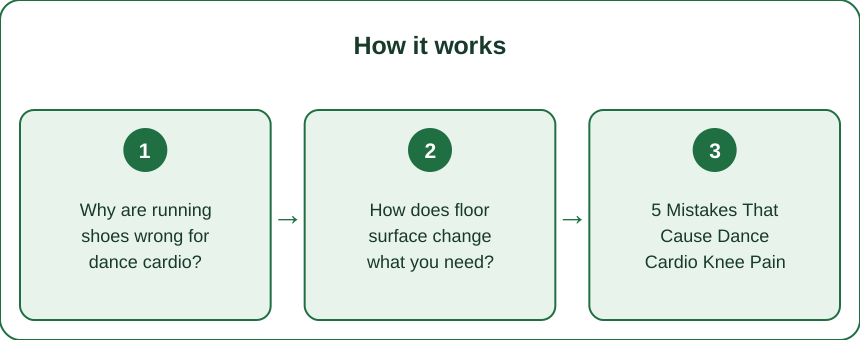
Why are running shoes wrong for dance cardio?
Three design features, all of them good for running and bad here.
Outsole grip. Running shoes are built to resist forward slipping, with aggressive rubber patterns under the forefoot. Dance cardio involves constant pivoting — the ball of the foot rotating while the heel is off the ground. If the shoe grips and your body rotates, the rotational force has to go somewhere, and it goes into your knee. This is the single biggest cause of dance-cardio knee complaints and it is entirely fixable.
Heel drop. Most running shoes have a 8 to 12mm difference between heel and forefoot height. That tilts you slightly forward, which is efficient for running gait and destabilising for lateral movement and quick direction changes.
Cushioning geometry. Thick soft heel cushioning is designed to absorb repeated straight-ahead impact. On lateral movements it compresses unevenly, which is why your ankle feels like it is rolling slightly on side steps.
What you want instead: a flat or low-drop shoe (0 to 6mm), with a smooth pivot point under the ball of the foot, firm lateral support, and flexibility through the forefoot. That is essentially the description of a cross-trainer or a dance sneaker, both of which exist specifically because this problem is well known in the dance world.
How does floor surface change what you need?
Dramatically, and this is why the same shoes feel great in one room and terrible in another.
Hardwood or laminate. The most forgiving for pivots and the least forgiving for impact. You want a shoe with a smooth or circular pivot patch at the forefoot and reasonable cushioning. Hardwood over a joisted floor has some natural give; hardwood over a concrete slab has none, and the difference is significant for anything with jumping.
Carpet. The trap surface. Carpet grips shoes hard, and the fibres catch the outsole in exactly the way that causes knee twist. Carpet is also uneven under load. If carpet is your only option, the best answer is either a smooth-soled dance sneaker or, counterintuitively, socks with grip dots for lower-impact routines — plus a mat for anything with jumping.
Tile or concrete. Hard, unforgiving, and usually slippery when you sweat. This is the surface where cushioning matters most and where a mat is genuinely worth it rather than optional.
Exercise mat or rubber flooring. The best all-round option if you have the space. Enough give for impact, enough smoothness for pivots. A 6mm rubber mat is a cheap fix that solves both problems at once.
The practical test for any shoe-and-floor combination: stand with your weight on the ball of one foot and try to rotate 90 degrees. If it takes effort, your knee is absorbing that effort during the workout.
5 Mistakes That Cause Dance Cardio Knee Pain
1. Wearing running shoes. Covered above, and it is the most common by a wide margin.
2. Going barefoot on a hard floor. Barefoot solves the pivot problem completely and creates an impact problem. For low-impact routines on wood, barefoot is often excellent. For anything with jumping on tile or concrete, it is a foot and shin injury waiting to develop.
3. Pivoting on the heel instead of the ball of the foot. A technique issue rather than a gear issue, but it multiplies the gear issue. Pivots should happen on the ball of the foot with the heel lifted. Heel pivots load the knee directly with no ability for the foot to absorb rotation.
4. Keeping shoes long past their useful life. Dance cardio wears the forefoot outsole in a very specific spot. Once that pivot patch has worn rough or gone flat, the shoe grips differently than it did when new. Check the ball of the foot, not the heel, when deciding whether shoes are done.
5. Landing with locked knees. The one that surprises people, because it feels like good posture. Every landing should have a soft knee bend to absorb force. Locked-knee landings send the impact straight into the joint, and on a hard floor in cushioned shoes you often do not feel it happening until the next day.
What should you actually buy?
You do not need a dedicated dance shoe unless you dance a lot, but you do need something other than your running shoes.
Cross-trainers are the practical default. They are designed for multidirectional movement, they have flatter soles and firmer lateral support, and you probably want one anyway for strength work. Look for a forefoot you can twist with moderate hand pressure and a sole that is smooth rather than lugged under the ball of the foot.
Dance sneakers have a split sole and a built-in pivot disc, and they are unbeatable if dance cardio is your main activity. The split sole allows the foot to articulate, which feels strange for the first session and then feels obviously correct. They are less useful for anything else.
Grip socks work well for low-impact routines on smooth floors and are a genuinely good option for apartment workouts where noise matters. Not appropriate for jumping.
Budget reality: a decent cross-trainer runs $60 to $110, and dance sneakers are usually similar. If you are not ready to spend, the cheapest meaningful upgrade is a rubber exercise mat for around $25 — it changes the floor rather than the shoe, and it solves the pivot problem for whatever you already own.
One fitting note: size dance and cross-training shoes closer to your true length than you would running shoes. The half-size-up rule for running exists because feet swell and slide forward on descents. Here, extra room means your foot moves inside the shoe during lateral work, which is its own problem.
FAQ: Dance Cardio Shoe Questions, Answered
Can I do dance cardio in socks on hardwood?
Plain socks are too slippery and cause the opposite problem — losing your footing during weight transfers. Grip socks with rubber dots are a reasonable middle ground for low-impact routines. Anything with jumping needs more support.
How long should dance cardio shoes last?
Roughly six to nine months at three sessions a week, which is shorter than most people expect. The pivot area wears faster than a running shoe’s heel does. Watch the forefoot texture.
Do I need arch support?
Only if you already need it for everything else. Dance cardio does not create a specific arch support requirement, and the flexible flat soles that work best here generally have modest support. If you use orthotics daily, use them here too and choose a shoe with a removable insole.
Why do my calves get so sore in dance cardio compared to other workouts?
Because you spend much of it on the balls of your feet with the heel lifted, which is a sustained calf contraction. This is normal and it settles after a few weeks. Flat shoes make it more noticeable initially than cushioned high-drop running shoes did, which is a fair trade for the knee benefit.
Does this apply to online classes at home differently than studio classes?
Yes, mainly because home floors vary so much more. A studio has a sprung floor designed for this. Your living room has whatever the previous owner installed. The shoe that works in a studio may not work at home, and the floor is the variable you can least change.
TL;DR:
- Running shoes grip when you need to pivot — that rotational force ends up in your knee.
- Use a flat, flexible cross-trainer or dance sneaker with a smooth forefoot.
- Match to your floor: carpet is the worst for pivots, a 6mm rubber mat fixes most surfaces cheaply.
- Replace based on forefoot wear, roughly every six to nine months.
Dance cardio has a reputation as a joint-friendly workout, and it earns that reputation when the equipment matches the movement. If your knees have been complaining, change the shoes before you change the workout.
Keep Reading
This article is for general informational and styling purposes only. Fit, sizing, and product availability may vary.