Sore Hips After Dance Cardio — Normal Soreness or a Warning Sign?
Quick Answer: Mild, symmetrical soreness in the outer hip and glute area 24-48 hours after class is normal DOMS from lateral movement your muscles aren’t used to. Sharp, one-sided pain, or pain during the class itself, points to a form issue worth addressing before your next session.
Dance cardio hits your hips from angles that running, cycling, and most gym machines never touch — lateral shuffles, hip circles, quick direction changes — which is exactly why the soreness can catch people off guard.

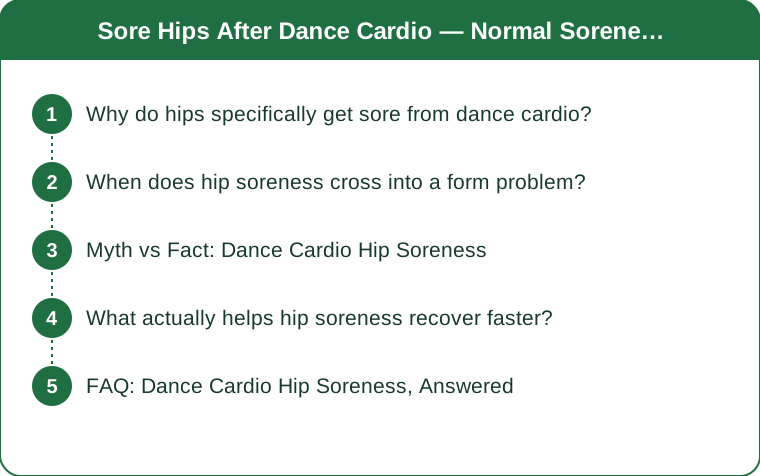
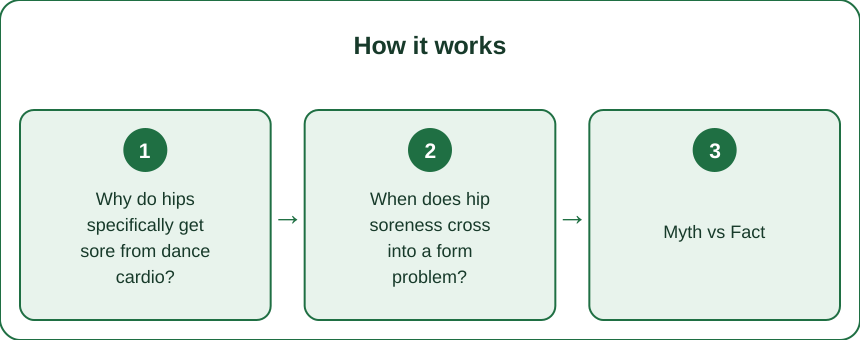
Why do hips specifically get sore from dance cardio?
Most cardio formats (running, cycling, the elliptical) move you in a single plane — forward and back. Dance cardio adds lateral and rotational movement: side-to-side shuffles, hip isolations, pivots. Your hip abductors and rotators, which barely engage in linear cardio, suddenly do a lot of work, and undertrained muscles get sore fastest when asked to do something new.
This is a normal training response, not a sign you did something wrong — it usually fades within 2-3 sessions as those muscles adapt.
When does hip soreness cross into a form problem?
One-sided soreness that’s noticeably worse on one hip than the other often points to compensation — favoring your stronger side during quick transitions, which overloads it. Pain during the movement itself, rather than soreness that shows up hours later, is a different signal entirely and usually means a joint or tendon issue rather than muscle fatigue.
Sharp, pinching pain in the front of the hip during high kicks or leg lifts specifically can indicate hip flexor strain from overreaching on range of motion before your body is warmed up enough.
Myth vs Fact: Dance Cardio Hip Soreness
Myth: Soreness means the workout was more effective. Fact: Soreness intensity doesn’t reliably correlate with fitness gains — it mostly reflects how unfamiliar the movement pattern was, which is why soreness fades with repeated exposure even as the workout keeps working.
Myth: You should push through hip pain to “work through it.” Fact: Pushing through sharp or one-sided pain during class is how minor strains become bigger ones. Modifying the movement (smaller range, lower impact) is the better move.
Myth: Stretching before class prevents all soreness. Fact: Dynamic warm-ups help reduce injury risk, but they won’t eliminate normal DOMS from a new movement pattern — that’s just how muscle adaptation works.
What actually helps hip soreness recover faster?
Gentle hip circles, figure-4 stretches, and short walks the day after class promote blood flow to the area without stressing it further. Foam rolling the outer hip and glute (not directly on the hip bone) can ease tightness. Avoid another high-intensity lateral session until soreness meaningfully eases — back-to-back sessions on already-sore, undertrained muscles is when overuse issues tend to start.
FAQ: Dance Cardio Hip Soreness, Answered
Is it normal for hip soreness to last longer than regular leg-day soreness?
Somewhat — because the muscles involved (hip abductors, rotators) are less trained in most people, initial soreness can run 3-4 days versus the typical 1-2 for more commonly used muscles, especially in your first few classes.
Should I ice or heat sore hips after class?
Heat generally works better for muscle soreness (improves blood flow), while ice is more appropriate for an actual injury with swelling. If you’re unsure which you’re dealing with, that uncertainty itself is a reason to ease off rather than guess.
How many classes before hip soreness stops happening?
Most people notice a significant drop by their 4th-6th class as the specific muscles adapt to lateral loading — it doesn’t disappear entirely, but it stops being disruptive.
TL;DR:
- Hip soreness from dance cardio is normal — you’re using lateral muscles regular cardio skips
- One-sided soreness or pain during the movement itself signals a form issue, not just DOMS
- Adaptation typically happens within 4-6 classes
- Heat and gentle movement help recovery; pushing through sharp pain doesn’t
Sore hips after your first few classes are expected — just keep an eye on whether it’s even, and whether it fades between sessions.
Keep Reading
This article is for general informational and styling purposes only. Fit, sizing, and product availability may vary.