Why Dance Cardio Feels Harder on Some Songs Than Others (Same Class, Same Length)
Quick Answer: Perceived difficulty in dance cardio tracks more closely with choreography complexity and directional changes than with raw BPM — a song with frequent direction changes, arm-leg coordination, or syncopated rhythm demands more neuromuscular effort at the same tempo than a straightforward, repetitive movement pattern.
If you’ve noticed one song in a class routinely leaves you more winded than another at a similar tempo, that’s a real, measurable difference — not just a mental read of the music.

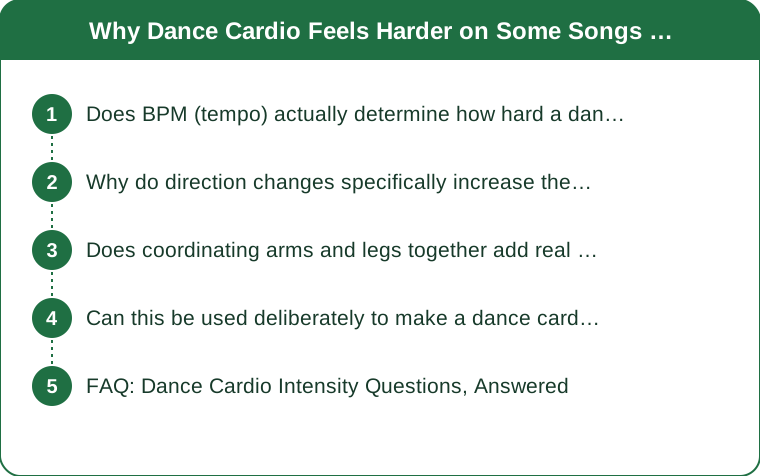
Does BPM (tempo) actually determine how hard a dance cardio segment feels?
BPM sets a baseline pace, but it’s not the dominant factor in perceived and actual effort — a moderate-tempo song with complex, direction-changing choreography can produce a higher heart rate response than a faster song with simple, repetitive steps, because the complexity itself demands more energy and coordination.
Why do direction changes specifically increase the effort level so much?
Changing direction requires deceleration and re-acceleration of body mass, which is more metabolically costly than continuing movement in one direction at the same speed — this is the same principle behind why agility drills feel harder than straight-line running at a comparable pace.

Does coordinating arms and legs together add real cardiovascular demand, or is it just harder to follow?
Both — coordinating upper and lower body simultaneously recruits more total muscle mass at once, which genuinely raises heart rate and oxygen demand, while the coordination challenge itself adds a cognitive load that can increase perceived effort beyond the physical demand alone.
Can this be used deliberately to make a dance cardio routine more effective?
Yes — choosing or choreographing sequences with more direction changes and cross-body coordination, even at a moderate tempo, can produce a more effective cardiovascular workout than simply chasing a higher BPM playlist, which is useful for anyone limited by joint stress from high-impact, high-tempo routines.
FAQ: Dance Cardio Intensity Questions, Answered
Should I pick faster songs if my goal is a harder workout?
Complexity and direction changes matter more than raw speed — a moderate-tempo song with more complex movement can be a more effective (and often lower-impact) choice than simply speeding up.
Why does the same song feel easier the second or third time doing that routine?
Once the choreography is memorized, the neuromuscular coordination demand drops significantly, which is a big part of why a familiar routine feels easier even though the physical movements are identical.
Is it normal for heart rate to spike more during complex sections and dip during simple ones within the same song?
Yes, this pattern is common and reflects the real difference in effort demand described above — it’s a normal and expected pattern in interval-style dance cardio rather than a sign of inconsistent effort.
TL;DR:
- Choreography complexity and direction changes drive perceived difficulty more than tempo alone
- Direction changes cost more energy due to deceleration and re-acceleration
- Coordinating arms and legs together raises both muscle recruitment and cognitive load
- A moderate-tempo, complex routine can out-train a fast, simple one
That harder song isn’t in your head — it’s genuinely asking more of your body.
Keep Reading
This article is for general informational and styling purposes only. Fit, sizing, and product availability may vary.