Why Dance Cardio Hits Different in a Hot Room
Quick Answer: Dance cardio has fewer natural pauses than almost any other group format, so heart rate stays elevated continuously and heat accumulates without a break to shed it. In a warm room, expect heart rate 10 to 20 beats higher at the same choreography. The adjustments that work: take the low-impact option every fourth song, position yourself near airflow, and drink 6 to 8 ounces every 15 minutes rather than waiting for the end.
The playlist is identical to the one you loved in February. The class is not. And a room of thirty people is generating a genuinely large amount of heat.
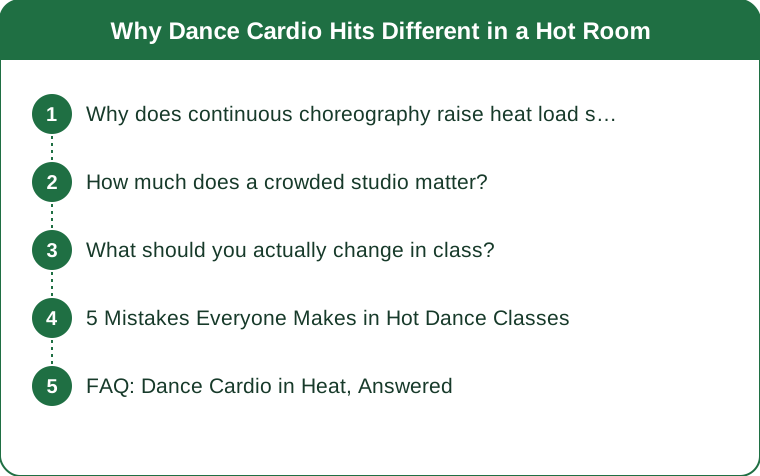
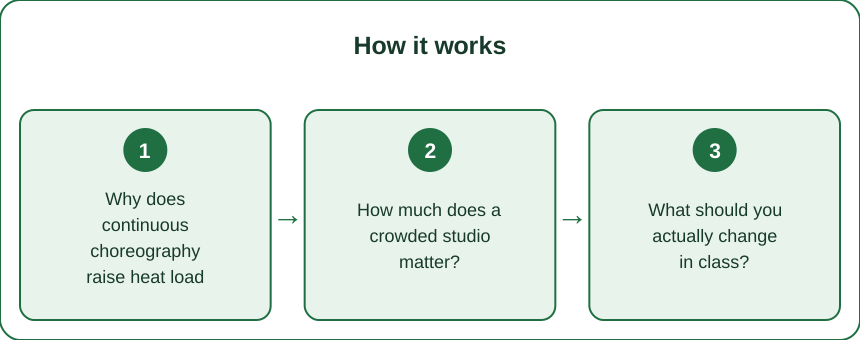
Why does continuous choreography raise heat load so much?
Interval-based formats build in recovery whether or not you plan it - rack the weight, walk back to the start, set up the next round. Those seconds are when your body catches up on heat dissipation.
Dance cardio has almost none of them. Songs transition directly, and the low-intensity moments are still moving moments.
The result is that heat production stays continuous while heat loss stays constrained. Core temperature climbs steadily instead of plateauing, and heart rate drifts upward across the class even though the choreography never intensifies.
That upward drift is the specific feeling people describe as the class getting harder in the last twenty minutes.
How much does a crowded studio matter?
More than the thermostat. A person at moderate exercise intensity produces roughly 400 to 700 watts of heat. Thirty people in a room is a substantial heat source, and it raises both air temperature and humidity as sweat evaporates into a closed space.
High humidity in the room is the bigger problem, because it directly limits evaporative cooling - the mechanism doing most of the work.
This is why the back corner near the door often feels dramatically better than the middle of the floor, and why studios with real airflow are worth choosing over prettier ones without.
What should you actually change in class?
Take the low-impact option deliberately, not just when you are struggling. Every fourth song, choose the modification. It drops heat production without dropping participation.
Drink on a schedule. 6 to 8 ounces every 15 minutes rather than a big gulp at the end. Waiting until you feel thirsty means you are already behind.
Position yourself near airflow - a fan, a door, an open window. Moving air across skin is the single biggest comfort variable in a hot studio.
Pre-cool. A cold drink in the ten minutes before class measurably lowers starting core temperature and buys you a longer runway.
Skip the extra layer. Long sleeves in a hot studio for coverage is understandable, but a light loose tank over a supportive top does the same job with far better evaporation.
5 Mistakes Everyone Makes in Hot Dance Classes
Going full intensity on the first three songs. The class is 45 minutes and heat accumulates. Starting at 100 percent means finishing at 60.
Front row by default. It is often the hottest and least ventilated spot, and it is the hardest place to take a modification without feeling watched.
No towel. Sweat sitting on skin does not cool you - evaporation cools you, and a soaked layer of sweat actually slows it. Blot rather than wipe.
Skipping the cool-down to beat traffic. This is the third mistake and it is the one that ruins the rest of the evening, because core temperature stays elevated for an hour afterward.
Treating dizziness as a sign to push. Lightheadedness in a hot room is a stop signal. This is general information, not medical advice.
FAQ: Dance Cardio in Heat, Answered
Why is my heart rate so much higher for the same class?
Cardiac drift from heat - the heart beats faster to send more blood to the skin for cooling while still supplying muscles. Expect 10 to 20 beats at the same effort in a warm room.
Should I switch to a shorter class in summer?
A 30-minute class in a hot room is often more productive than a 60-minute one you fade through. If only the long class is offered, plan to modify the last third.
Is sweating more a sign of better fitness?
Somewhat, yes - trained and heat-acclimatized people start sweating earlier and sweat more efficiently. It is a sign of adaptation, not of working harder.
TL;DR:
- Dance cardio lacks natural rest points, so heat accumulates continuously and heart rate drifts upward through class.
- A crowded studio adds significant heat and humidity, and humidity is what blocks your cooling.
- Take the low-impact option every fourth song, drink 6 to 8 ounces every 15 minutes, and find airflow.
- Pre-cool with a cold drink before class - it buys more than anything you do at minute 35.
The choreography did not get harder. The room got harder. Adjust for the room and the class goes back to being the fun part of the day.
Keep Reading
This article is for general informational and styling purposes only. Fit, sizing, and product availability may vary.