Why Dance Cardio Makes You Sorer Than Workouts That Felt Harder
Quick Answer: Dance cardio produces disproportionate soreness because of movement novelty and eccentric loading, not because it is harder. Unfamiliar patterns recruit muscles in unpractised ways, and the constant deceleration and direction changes involve eccentric contractions - the type most strongly associated with delayed onset muscle soreness. A familiar 45-minute run and an unfamiliar 30-minute dance class produce very different next-day results for reasons unrelated to effort.
You did a run that felt genuinely hard on Tuesday and felt fine on Wednesday.
You did a dance workout on Thursday that felt fun and manageable, and on Saturday you cannot go down stairs properly.
This is general information, not medical advice.

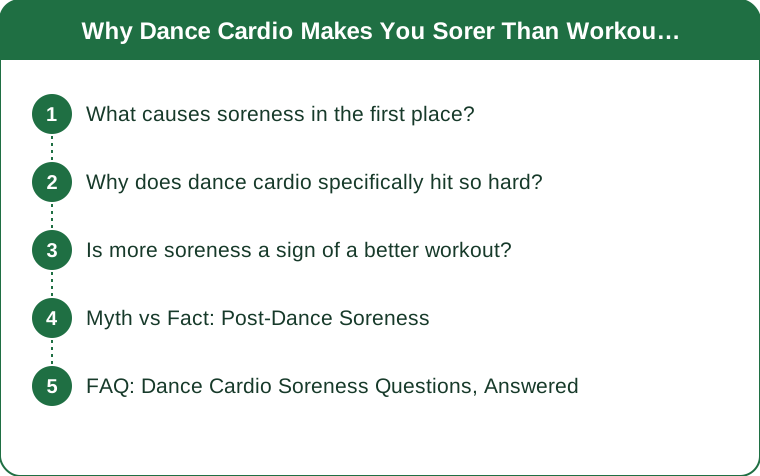
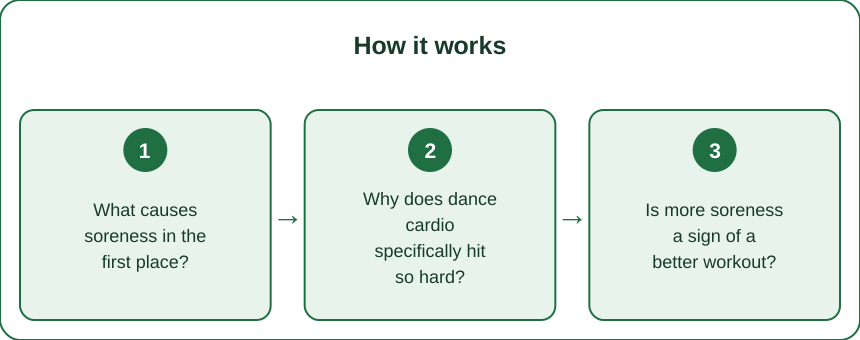
What causes soreness in the first place?
Not what most people were told, and the correction matters.
Delayed onset muscle soreness - DOMS - typically appears 12-24 hours after exercise and peaks around 24-72 hours. The delay is the defining feature and the clue to the mechanism.
It is not lactic acid. Lactate clears from muscle within roughly an hour of exercise finishing, which is nowhere near the timescale of soreness that peaks two days later. This explanation persists in gyms decades after being superseded.
What the evidence supports instead: microscopic damage to muscle fibres and connective tissue, followed by an inflammatory response. The soreness is largely a consequence of that repair process rather than of the damage itself, which is part of why the timing lags.
Eccentric contractions produce far more of it. An eccentric contraction is one where the muscle produces force while lengthening - lowering a weight, absorbing a landing, controlling a descent. Eccentric loading is consistently associated with more DOMS than concentric loading at equivalent effort.
Novelty is the other major driver. Unfamiliar movements produce more soreness than familiar ones at the same intensity, and the repeated bout effect means the same session produces much less soreness the second time. That effect is well documented and quite protective - it appears after a single exposure and lasts for weeks.
Which sets up the whole explanation for dance cardio: it is maximally novel and full of eccentric loading, while feeling moderate in effort.
Why does dance cardio specifically hit so hard?
Four features stacked on top of each other.
Movement novelty is unusually high. Most cardio is repetitive - running is the same pattern thousands of times. A dance class might contain dozens of distinct movement patterns, many of which you have never performed. Every unfamiliar pattern is a fresh stimulus to muscles that have not adapted to it.
Direction changes involve constant deceleration. Every side step, pivot and stop requires eccentric work to absorb momentum. A run in a straight line has almost none of this - you accelerate once and maintain. Dance cardio decelerates dozens of times per song.
Lateral and rotational movement recruit undertrained muscles. Running, cycling and most gym cardio are almost entirely sagittal - forward and back. Dance moves through all three planes, which loads adductors, abductors, obliques and deep hip rotators that rarely get direct work. Those muscles are undertrained in most people, so the same relative stimulus produces more soreness.
The effort feels lower than it is. Music, choreography and enjoyment all reduce perceived exertion - a well-documented effect. You work harder without registering it, and there is no pace or weight number giving you objective feedback.
Add one seasonal factor: home dance workouts in a warm late-summer room raise heart rate for a given effort, which further decouples how hard it feels from how much work you did.
None of which means dance cardio is unusually damaging. It means the relationship between how a session feels and how sore you will be is different from what your other training taught you to expect.
Is more soreness a sign of a better workout?
No, and this is worth being clear about.
Soreness reflects novelty and eccentric load far more than it reflects training effect. You can produce substantial soreness with a single unfamiliar session that provides little fitness benefit, and produce meaningful adaptation with no soreness at all.
The clearest demonstration is the repeated bout effect. Do the same class again in a week and you will be far less sore - your fitness has not jumped in a week. The stimulus is simply no longer novel.
What to actually use as feedback:
- Performance over weeks - can you do more, or the same with less effort
- How you feel during the session, not two days later
- Consistency - the strongest predictor of results by a considerable margin
What soreness is genuinely useful for: flagging that a movement was unfamiliar. Very sore adductors after a dance class tells you those muscles are undertrained, which is useful information about what to work on directly.
When soreness is a warning rather than information:
- Sharp or localised pain rather than diffuse muscle ache
- Soreness lasting beyond about 5-7 days
- Significant swelling, or dark urine - rare, and a reason to seek medical attention promptly
- Pain in a joint rather than in muscle
The training implication: if you chase soreness, you will keep changing your workout to stay novel and never adapt to anything. Repeating a class is what produces progress, and the reduced soreness is evidence that it is working.
Myth vs Fact: Post-Dance Soreness
Myth: It is lactic acid built up in the muscles. Fact: Lactate clears within about an hour. DOMS peaks at 24-72 hours. The timelines rule it out entirely.
Myth: Stretching afterward prevents it. Fact: Research on stretching before or after exercise has consistently found little to no effect on DOMS. Stretching has other benefits; this is not one of them.
Myth: You should rest completely until it is gone. Fact: Light movement generally reduces soreness temporarily and does not impair recovery. A gentle walk or easy session is usually more comfortable than doing nothing.
Myth: More soreness means a better session. Fact: Soreness tracks novelty and eccentric load, not training effect. The second time you do a class you will be less sore and getting more from it.
Myth: If you never get sore, you are not working hard enough. Fact: Adapted muscles produce far less soreness at the same workload. Consistency is what removes soreness, and it is the thing producing results.
Myth: Protein or a supplement will prevent it. Fact: Adequate protein supports recovery generally, and no supplement reliably prevents DOMS. Gradual progression and repeating sessions are what work.
FAQ: Dance Cardio Soreness Questions, Answered
Should I do another class while still sore?
Generally yes, if the soreness is moderate. Light to moderate movement often reduces discomfort, and there is no evidence that training through mild DOMS impairs recovery. If it is severe enough to change how you move, wait a day or reduce intensity.
How do I get less sore next time?
Repeat the same class or routine. The repeated bout effect kicks in after a single exposure and substantially reduces soreness for weeks. Constantly switching to new routines keeps you permanently in the novel-stimulus state.
Why are my inner thighs always the sorest part?
Adductors do a lot of work in lateral movement and get almost no direct training in running, cycling or most gym routines. They are undertrained relative to your quads and glutes, so the same class hits them harder.
Does a warm-up prevent soreness?
A warm-up reduces injury risk and improves how the session feels, and the evidence for it preventing DOMS specifically is weak. Do it for the first two reasons.
What actually helps once I am sore?
Light movement, adequate sleep and sufficient protein are the things with reasonable support. Massage and cold water immersion have some evidence for short-term symptom relief. Mostly it resolves on its own in a few days.
When should soreness worry me?
If it is sharp rather than diffuse, located in a joint, lasting beyond about a week, or accompanied by significant swelling or dark urine. That last combination is rare but warrants prompt medical attention.
TL;DR:
- DOMS comes from muscle fibre damage and the repair response, not lactic acid - lactate clears in about an hour
- Dance cardio is maximally novel and full of eccentric deceleration, which is the combination that produces soreness
- Lateral and rotational movement loads adductors and hip rotators that other cardio never touches
- Music and enjoyment lower perceived effort, so the session feels easier than the work you did
- Soreness tracks novelty, not training quality - the repeated bout effect proves it
- Repeat the routine rather than chasing new ones if you want progress rather than soreness
The class was not harder than your run. It was newer, and full of stopping.
Keep Reading
This article is for general informational and styling purposes only. Fit, sizing, and product availability may vary.